
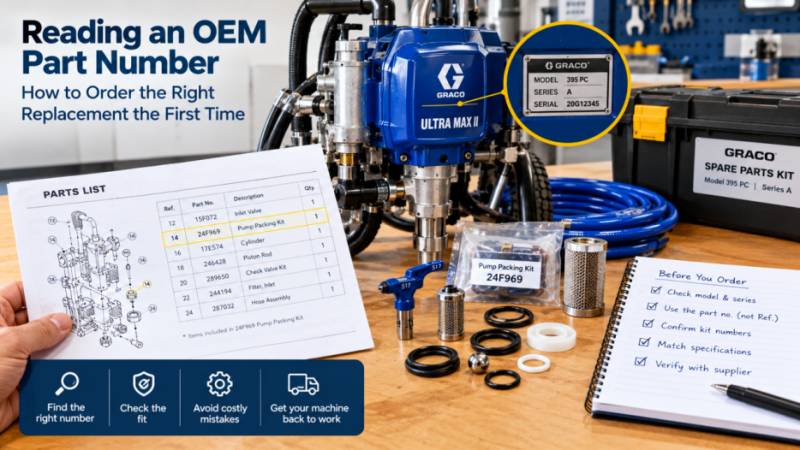
Ordering the wrong part is expensive in a way that is easy to underestimate. There is the cost of the part, the shipping both ways and a return fee on some orders, but the larger cost is the days a machine sits idle while the right part is found. Most wrong orders do not come from carelessness. They come from not knowing what a part number is telling you.
This guide explains how OEM (original equipment manufacturer) part numbers work in practice, using examples from airless paint sprayers. It covers the difference between a model and a series, the trap in parts diagrams, why kit numbers change between manual revisions and how to cross-reference an OEM number to an aftermarket equivalent. The examples are from Graco and Binks documents, but the checks apply to almost any equipment.
Key takeaways
- A part number identifies a part. A model and series identify the machine. You need both.
- In a parts diagram, the Ref. number is a callout on the drawing, not a part number. Order from the Part No. column.
- Kit numbers can change between manual revisions. Confirm against the current manual for your exact pump.
- When you buy an aftermarket replacement, the OEM number is the number to match.
- If anything is unclear, confirm by phone before you order.
What a part number actually is
An OEM part number is the manufacturer’s own identifier for one specific component or kit. Formats vary between manufacturers, and the number rarely explains itself.
- Plain six-digit numbersare the standard format in Graco’s manuals, for example 244851 or 246428. They are used for components, kits and even complete sprayer models.
- Alphanumeric numbersalso appear in current manuals, for example 24F967, 25D235 or 17E574. Graco does not publish a meaning for the letters or prefixes, so do not try to decode them. Treat the whole number as an opaque identifier.
- Dashed numbers, such as 6-229 or 54-1013, are a different convention. They are the style used in Binks spray gun documents, not Graco’s, and they also appear in aftermarket numbering. If a dashed number appears next to a Graco machine, ask what it refers to.
The practical lesson is to copy part numbers exactly, including every letter, and never to guess from a similar-looking number.
Model, series and serial number
Three more identifiers sit on the machine itself, usually on an ID plate or tag.
- Model number:identifies the product, such as a sprayer model. It is a six-digit part number in Graco’s system, and a pump can have a model number of its own.
- Series letter:a revision letter. Graco’s manuals list parts by model and series, because parts can change between series, even within the same model.
- Serial number:identifies the individual unit and sometimes its production date.
The same model name can also cover more than one configuration. Graco’s Ultra Max II 695, for example, comes in a Standard tier that lists one pump and a ProContractor tier that lists another. Naming a sprayer is not enough to identify its pump. Read the number on the plate and match it to the manual.
Where the plate sits depends on the machine. In some current manuals the model and serial tag is on the bottom of the unit, and on some electronic models you can display the serial number by holding a button at power-up. Your manual will show the location.
The parts-list trap: Ref. is not Part No.
A manufacturer’s parts list has columns that look similar and mean different things. In Graco’s lists, the columns are Ref., Part, Description and Qty.
- is the callout number in the exploded drawing. It tells you where a part sits in the picture.
- Part No.is the number to order from.
It is a common mistake to order from the Ref. column. Worse, the same Ref. numbers can carry different part numbers on different models or series, so a callout copied from a diagram for another pump will lead you to the wrong part.
Kits add one more layer. A kit is usually a single line that “includes” several smaller parts. Items marked with an asterisk are described as also included in a named repair kit, which can be purchased separately. In other words, the manual is telling you that the cheapest way to buy several small parts may be the kit. Read the notes under the list before you order individual pieces.
Why kit numbers change
One of the biggest sources of confusion is that kit numbers change over time. Graco’s manuals show examples:
| Item | What the manuals show |
| 180cc Xtreme full repair kit | Listed as 244851 in an older pump manual, 24F969 in a later one and 25D235 in the current lower manual |
| Ultra 395/495 pump repair kit | Listed as 244194 in older manuals; Graco’s current pump manual for the Ultra 395 PC lists 18B260 |
| Magnum X5 pump kit | Listed as 289650 for Series A and 16F047 for later series |
The manuals do not say that each new number is a drop-in replacement for the one before, so do not assume it. The safe reading is that kit numbers change between manual revisions, and that you should confirm the kit against the current manual for your pump. Keep an old number as a clue, and check it against the series on your machine.
Aftermarket parts: what the second number means
Many replacement parts are made by companies other than the original manufacturer. These aftermarket parts are designed to replace a named OEM part. A good listing makes the relationship clear. For example, the listing “Graco 25D235 Repair Kit Aftermarket Replacement | Bedford 20-3409” has two numbers. The first, 25D235, is the OEM number the part replaces. The second, after the pipe, is the aftermarket maker’s own part number.
Brand names in a listing like this identify the machine a part is intended for. They do not mean the part is made by that brand. If a listing does not make that clear, ask. A cross-reference from an OEM number to the aftermarket equivalent is the quickest way to move from the number on your old part to a matching replacement.
On warranty, be straightforward with yourself. Graco says that non-Graco replacement parts may void its warranty, and its warranty excludes damage caused by substituted parts. In the United States, federal law generally limits how far a manufacturer can tie a consumer-product warranty to branded parts, but it still lets a manufacturer deny coverage for damage an aftermarket part actually caused. If the equipment is still under warranty, ask the manufacturer first.
A step-by-step check before you order
- Photograph the ID plateand write down the model, series and serial number.
- Open the parts listfor that model and series in the current manual.
- Find the part in the drawing,then read across to the Part No. column. Do not use the Ref. number.
- Check for a kit.If the part is marked as included in a kit, decide whether the kit is the better buy.
- Compare the old partwith the listing: size, thread, shape and any markings.
- Match the specification,not just the number: pump ratio, pressure rating, thread type and fitting size where they apply.
- Confirm the fitwith the supplier if the number has more than one version, or the part is not shown in your manual.
Common ordering mistakes
- Ordering by the machine name alone.A name like “Ultra” or “Endurance” covers several models and pumps. Endurance, for instance, is a pump name, not a single pump.
- Using the Ref. number from the drawing.
- Assuming an old kit number still applies.
- Ignoring the series letter.
- Mixing up similar-looking numbers.One wrong character is a different part.
- Not checking the rating.A part rated below your machine is not a substitute, however well the rest matches.
What to do when the number does not match
Sometimes the number on the old part is worn, or it does not appear in the manual you have. That does not mean you are stuck. Use the model and series from the ID plate, the parts list for your machine and a photograph of the part. A reputable supplier will help you identify the part before it ships. If you would like a worked example for Graco machines, this guide from eRepairCenter goes through how to identify the correct part number before you order, with the examples above in more detail.
Frequently asked questions
What does an OEM part number mean?
It is the original manufacturer’s identifier for a specific part or kit. For most manufacturers the number does not carry a decodable meaning, so you should copy it exactly and use it as a lookup key rather than trying to interpret it.
What is the difference between a model number and a part number?
A model number identifies a product. A part number identifies a component or a kit. In some systems, including Graco’s, both are written as six-digit numbers, which is why it is important to know which one you are reading.
Can I use an aftermarket part if I only have the OEM number?
Yes, that is how most aftermarket listings work: they name the OEM number the part is designed to replace. Check that the listing describes the same part, and confirm the specification if it matters to your machine.
Why does my kit number not match the manual?
Kit numbers change between revisions, so an older or newer manual may show a different number for the same kind of kit. Check the series on your machine and use the manual that matches it.
The short version
Identify the machine by model and series, find the part in the drawing, order from the Part No. column and treat kit numbers as something to verify rather than assume. If a number is unclear, a quick call to the supplier is far cheaper than a return. A few minutes of checking before you order saves the days that a wrong part takes out of your schedule.
About the author
The eRepairCenter parts team helps painters, contractors and maintenance crews identify and replace worn parts on airless paint sprayers. eRepairCenter is a Houston, Texas supplier of aftermarket, used and surplus replacement parts and an authorized Bedford Precision distributor, shipping across the United States.See More