
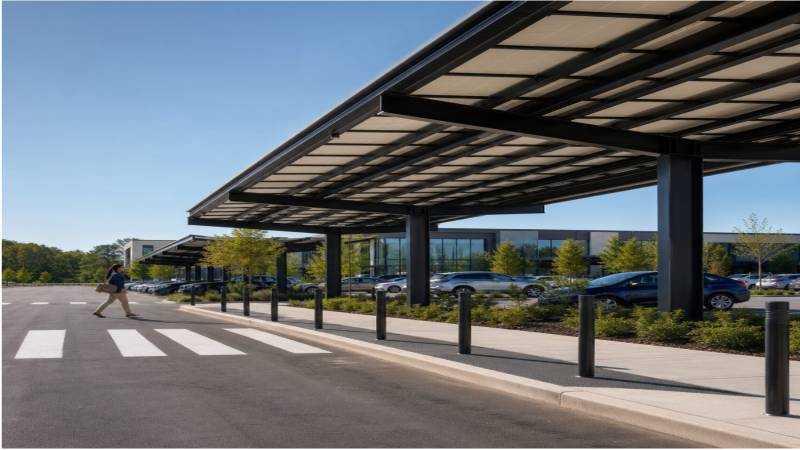
When we think about outdoor spaces — whether commercial, residential, or civic — we tend to compartmentalize them. Parking lots belong to one conversation, shade structures to another, and pedestrian safety to yet another. But in reality, these elements are deeply interconnected. A well-maintained parking lot sets the tone for an entire property. A thoughtfully designed shade structure transforms how people experience outdoor areas. And smart pedestrian infrastructure keeps everyone safe as they move through these spaces. Understanding how these elements work together is the first step toward creating outdoor environments that are functional, attractive, and genuinely safe.
The Foundation Beneath Your Feet: Why Pavement Condition Matters More Than You Think
Asphalt surfaces are among the most overlooked assets in commercial and residential property management. Owners often wait until cracks become potholes or fading becomes a liability before taking action — but by that point, the cost of repair has multiplied significantly. Pavement degradation doesn’t happen overnight. It’s a gradual process driven by UV exposure, freeze-thaw cycles, heavy vehicle traffic, and water infiltration. Each of these forces chips away at the structural integrity of the surface, and without proactive intervention, what starts as a hairline crack can evolve into a full-depth failure within a few seasons.
This is especially true in climates with dramatic seasonal swings. Denver, for example, experiences both intense summer heat and harsh winter conditions — a combination that accelerates asphalt deterioration faster than in more temperate regions. Investing in parking lot maintenance in Denver isn’t just about aesthetics; it’s about protecting a significant capital asset, reducing liability exposure, and ensuring that the first impression your property makes is a positive one. Sealcoating, crack filling, line striping, and drainage improvements are all components of a comprehensive maintenance strategy that extends pavement life by years.
The Real Cost of Deferred Maintenance
Industry data consistently shows that proactive pavement maintenance costs a fraction of full-depth replacement. A sealcoat applied every two to three years can double or even triple the lifespan of an asphalt surface. Crack filling, when done early, prevents water from penetrating the base layer — the most destructive form of pavement damage. Property managers who treat their parking lots as living infrastructure, rather than static concrete, consistently see better long-term returns on their investment. The math is straightforward: spend a little now, or spend a lot later.
Shade Structures: More Than Just Comfort
Once the ground-level infrastructure is in order, attention naturally turns upward — to the structures that define how people experience outdoor spaces. Shade structures, whether pergolas, patio covers, or tensile canopies, serve a dual purpose: they provide physical relief from sun and rain, and they define the character of an outdoor area. The choice between different shade solutions is rarely simple, and it depends heavily on climate, intended use, and aesthetic goals.
For property owners navigating this decision, understanding the functional differences between options is essential. A detailed comparison of pergola versus patio cover designs reveals that each solution has distinct advantages depending on the environment. Pergolas offer an open, airy feel with partial shade — ideal for spaces where airflow and natural light are priorities. Patio covers, by contrast, provide full overhead protection, making them better suited for areas that need to remain usable during rain or intense midday sun. In hot, sun-drenched climates, the distinction between these two options can significantly impact how often and how comfortably a space is actually used.
Integrating Shade Into Parking and Commercial Environments
Shade structures aren’t limited to residential patios. Commercial properties increasingly incorporate covered walkways, carport canopies, and shaded pedestrian corridors as part of their overall site design. These additions serve practical purposes — protecting customers from the elements, reducing heat island effects in large paved areas, and improving the overall experience of moving through a commercial space. When combined with well-maintained pavement and clear pedestrian pathways, shade structures contribute to a cohesive, professional outdoor environment that reflects positively on the business or institution that owns it.
Pedestrian Safety: The Human Element in Outdoor Design
No discussion of outdoor spaces is complete without addressing the safety of the people who use them. Parking lots, in particular, are high-risk environments for pedestrians. The combination of moving vehicles, limited sightlines, distracted drivers, and poorly marked crosswalks creates conditions where accidents are far more likely than most property owners realize. According to data from traffic safety researchers, a significant percentage of pedestrian injuries occur not on public roads, but in private parking facilities.
Addressing this risk requires a multi-layered approach. Clear, freshly painted crosswalks and directional markings help guide both drivers and pedestrians through the space safely. Speed bumps and raised pedestrian crossings slow vehicle traffic in high-foot-traffic areas. Adequate lighting ensures visibility during evening hours. And thoughtful layout design — separating pedestrian pathways from vehicle lanes wherever possible — reduces the number of conflict points where accidents can occur.
Innovative Approaches to Ground-Level Safety
Beyond traditional markings and signage, designers and urban planners are exploring more creative solutions to pedestrian safety. One compelling example involves embedding traffic signals directly into the pavement surface, making them visible to pedestrians who are looking down at their phones rather than up at conventional signals. This concept, explored in ground-level traffic light designs aimed at preventing pedestrian accidents, reflects a broader shift in how designers think about human behavior in shared spaces. Rather than expecting people to adapt to infrastructure, the infrastructure adapts to people — a principle that has broad implications for parking lot and outdoor space design.
Asphalt Coatings Company: A Trusted Partner in Denver Pavement Care
For property owners and managers in the Denver metro area, finding a reliable pavement maintenance partner is essential to protecting long-term property value. Asphalt Coatings Company has built a strong reputation in the region by delivering consistent, high-quality results across a wide range of commercial and residential projects. Their team brings deep expertise in the specific challenges posed by Colorado’s climate — from UV-accelerated oxidation in summer to freeze-thaw damage in winter — and they approach each project with a focus on durability, safety, and cost-effectiveness. Whether the need is routine sealcoating, comprehensive crack repair, or full parking lot restriping, their work reflects a commitment to quality that property owners can depend on season after season.
Conclusion: Thinking Holistically About Outdoor Spaces
The best outdoor spaces don’t happen by accident. They’re the result of deliberate decisions made at every level — from the condition of the pavement underfoot to the shade structure overhead to the safety systems that protect everyone moving through the space. These elements reinforce each other. A well-maintained parking lot signals professionalism and care. A thoughtfully chosen shade structure extends the usability of outdoor areas and improves comfort. And smart pedestrian safety measures protect the people who matter most. Treating these as separate concern’s misses the bigger picture. When approached holistically, outdoor space design becomes a genuine competitive advantage — one that improves property value, reduces liability, and creates environments where people genuinely want to spend time.